

Gulf Hyperscale Syndication
Gulf Hyperscale Syndication Confronts Cross-Border Underwriting
12 October 2026
The rapid expansion of specialized digital infrastructure across the Gulf Cooperation Council has entered a secondary financing phase characterized by sophisticated institutional syndication. Over the weekend, market developments highlighted a notable increase in private placement debt issuances and co-investment prospectuses targeting gigawatt-scale data center complexes across the United Arab Emirates. While global asset allocators have historically accessed compute capacity through balance-sheet financing of multinational cloud providers or developed-market real estate investment trusts, current capital structures increasingly rely on bespoke special purpose vehicles established alongside sovereign-backed investment entities.
This structural evolution reflects both the unprecedented scale of artificial intelligence capital expenditures and hyperscalers' desire to constrain asset-heavy liabilities within off-balance-sheet vehicles. By partnering with sovereign wealth platforms, technology operators secure dedicated power allocations, industrial land grants, and preferential municipal infrastructure access. In exchange, regional vehicles are issuing mezzanine credit, project bonds, and private equity tranches to international institutional investors seeking long-duration, asset-backed yields. The resulting contractual arrangements, however, depart significantly from conventional European and North American infrastructure underwriting standards.
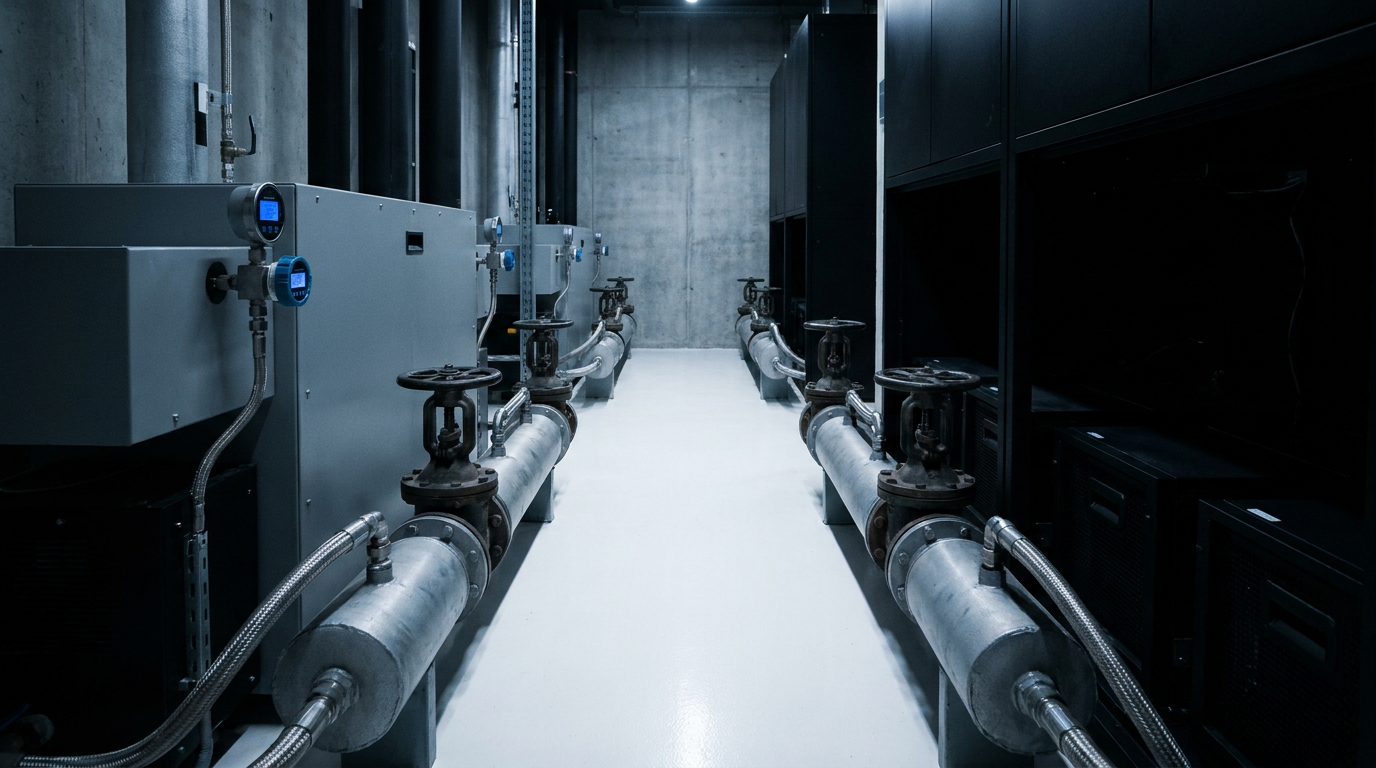
Underwriting debt service coverage ratios for arid-climate compute facilities introduces distinct operational friction. Ambient operating temperatures across the Gulf routinely exceed forty-five degrees Celsius during summer months, rendering standard air-cooling systems economically unviable and mechanically insufficient. Consequently, these installations require closed-loop liquid cooling, direct-to-chip chilled water systems, or immersion thermal management architectures supported by captive power generation. The parasitic energy load required merely to maintain safe thermal operating thresholds increases non-linearly during peak seasonal grid demand, elevating unit operational expenditure and altering standard power usage effectiveness ratios.
Furthermore, the physical depreciation profile of enterprise accelerator hardware in high-temperature environments diverges from historical server cycle norms. When capital assets are financed over twelve- to fifteen-year debt amortisation horizons, the underlying computational equipment requires complete refresh cycles every three to four years. Institutional lenders are therefore exposed to terminal asset risk if off-take agreements do not explicitly contract long-term capacity payments independent of technological obsolescence. While sovereign-backed off-takers provide formidable credit enhancement, debt covenants must navigate the precise apportionment of modernization capital between operating sponsors and syndicated lenders.
Cross-border regulatory and export-control oversight presents an equally critical variable for risk managers. Enterprise facilities operating top-tier semiconductor architectures remain subject to extraterritorial scrutiny and licensing mandates administered by foreign export authorities, notably the United States Department of Commerce. Financial vehicles backing regional data campuses must integrate stringent custodial monitoring protocols and chain-of-custody certifications into their loan documentation. Any mid-cycle revision to dual-use technology export regimes or cross-border compute access authorizations could immediately impair facility utilization rates, testing force majeure provisions and debt acceleration clauses.
For institutional investors evaluating exposure to alternative infrastructure, the institutionalization of Gulf digital real estate offers an attractive yield premium relative to tightening core infrastructure spreads. Yet the realization of projected returns remains contingent on strict scrutiny of engineering assumptions and geopolitical governance. Allocators must differentiate between the structural safety implied by sovereign sponsorship and the complex operational realities of thermodynamic efficiency, hardware replacement cadences, and shifting bilateral compliance architecture.
This commentary is provided for general information only and does not constitute investment, legal or tax advice.