

Defense Munitions Capitalization
Munitions Pre-Funding Shifts Risk to Defense Balance Sheets
30 September 2026
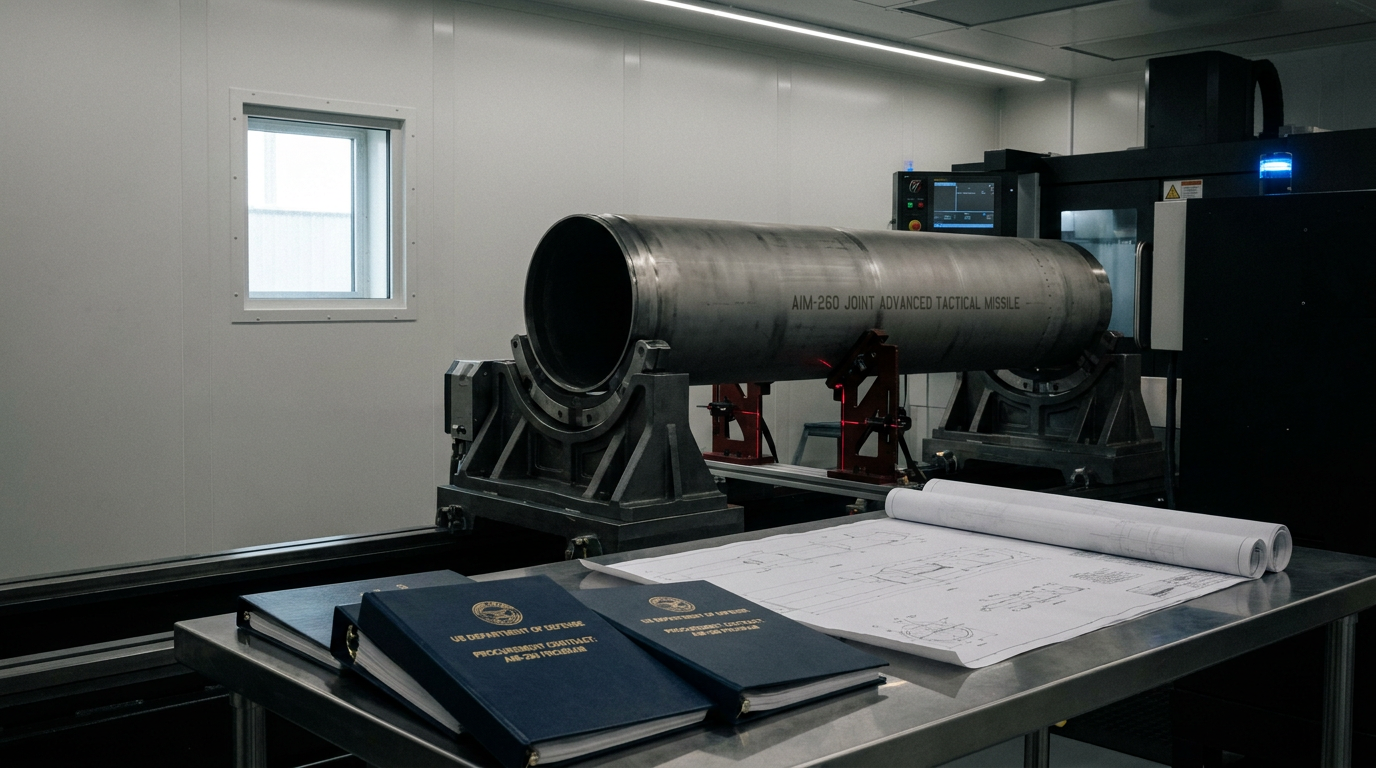
The intersection of escalating geopolitical competition and institutional procurement rigidity is reshaping the capital allocation strategies of global defense contractors. Recent corporate disclosures indicating that Lockheed Martin is committing corporate capital toward production infrastructure for the Joint Advanced Tactical Missile program ahead of finalized multiyear procurement contracts underscore an evolving risk distribution between sovereign defense departments and prime contractors. For institutional allocators, this willingness to absorb front-end capital expenditures signals both persistent baseline demand and a structural realignment in how long-cycle aerospace programs are capitalized.
Historically, major defense development programs operated under cost-plus arrangements that insulated corporate balance sheets from the initial costs of capacity expansion, specialized tooling, and long-lead supply chain commitments. However, budgetary constraints and political pressure for accelerated delivery timelines have increasingly compelled defense ministries to require industrial partners to demonstrate physical throughput capability prior to authorizing full-rate production funding. In the case of next-generation air-to-air munitions, the urgency to field deterrence capabilities across contested operating environments has outpaced the bureaucratic pace of legislative appropriations. Contractors are consequently forced to choose between absorbing working capital drag or risking loss of program primacy to competitors possessing greater liquidity buffers.
This pre-funding mechanism introduces distinct working capital friction into contractor balance sheets. Allocating corporate cash toward inventory buildup, precision machining equipment, and dedicated facility space compresses near-term return on invested capital while elevating asset specificity risk. Should legislative disputes delay program appropriations or alter annual procurement quantities, the contractor bears the financial burden of stranded capacity or extended amortization schedules. Nevertheless, prime contractors with robust investment-grade balance sheets view these capital deployments as high-moat barriers to entry. By self-funding early production tooling, incumbent manufacturers entrench their position within critical defense architectures, effectively turning balance sheet scale into a competitive differentiator that smaller specialized suppliers cannot replicate.
The broader implications extend directly to enterprise cash flow dynamics and sovereign industrial policy. In both North America and Western Europe, sovereign defense planners are grappling with industrial base fragilities exposed by persistent munitions replenishment demands. Government agencies increasingly rely on corporate balance sheets to act as interim financing vehicles, bridging the temporal gap between strategic necessity and statutory budget authorization. For public equity and fixed-income investors, this dynamic demands rigorous scrutiny of free cash flow conversion rates. Working capital intensity across the aerospace and defense sector has risen markedly, transforming what were once predictable cash-distributive enterprises into capital-reinvesting entities managing elevated supply-chain commitments.
From an institutional vantage point, the financial sustainability of this model hinges on the durability of procurement backlogs and the eventual structure of multiyear awards. Multiyear contract vehicles typically deliver superior margin predictability and procurement volume stability once enacted, providing the compensatory economic return for early capital exposure. However, until such contracts transition from budgetary intentions to legally binding commitments, contractors must absorb interest expense on debt-financed capital additions within an environment of elevated baseline yields. Corporate treasurers must balance shareholder expectations regarding dividends and share repurchases against the imperative to retain sufficient balance sheet flexibility to support state-directed manufacturing scale.
As global defense modernization programs navigate political and fiscal friction, the operational boundary between sovereign defense financing and corporate working capital continues to blur. Institutional capital allocators must differentiate between prime contractors capable of converting specialized capital outlays into enduring program monopolies and those merely assuming uncompensated balance sheet risk on behalf of state procurement authorities. In an era defined by industrial rearmament, capital discipline remains the ultimate determinant of long-term economic value creation across the defense aerospace sector.
This commentary is provided for general information only and does not constitute investment, legal or tax advice.