

Optical Interconnect Dispersion
Optical Interconnect Dispersion Exposes Datacenter Bottlenecks
25 September 2026
Global capital expenditure across high-performance computing infrastructure continues to reorder valuation benchmarks across the physical hardware stack. During Wednesday's trading session, equity markets exhibited pronounced internal dispersion within the communications equipment and hardware components sector. While aggregate semiconductor indices consolidated recent gains, price action across the physical connectivity layer bifurcated decisively. High-speed photonic component specialists recorded substantial advances, exemplified by Lumentum rising nearly ten percent, while diversified passive fiber and structural glass producers, including Corning, remained largely inert. This structural divergence signals a definitive transition in market sentiment, shifting focus from baseline physical buildouts toward critical signal transmission bottlenecks.
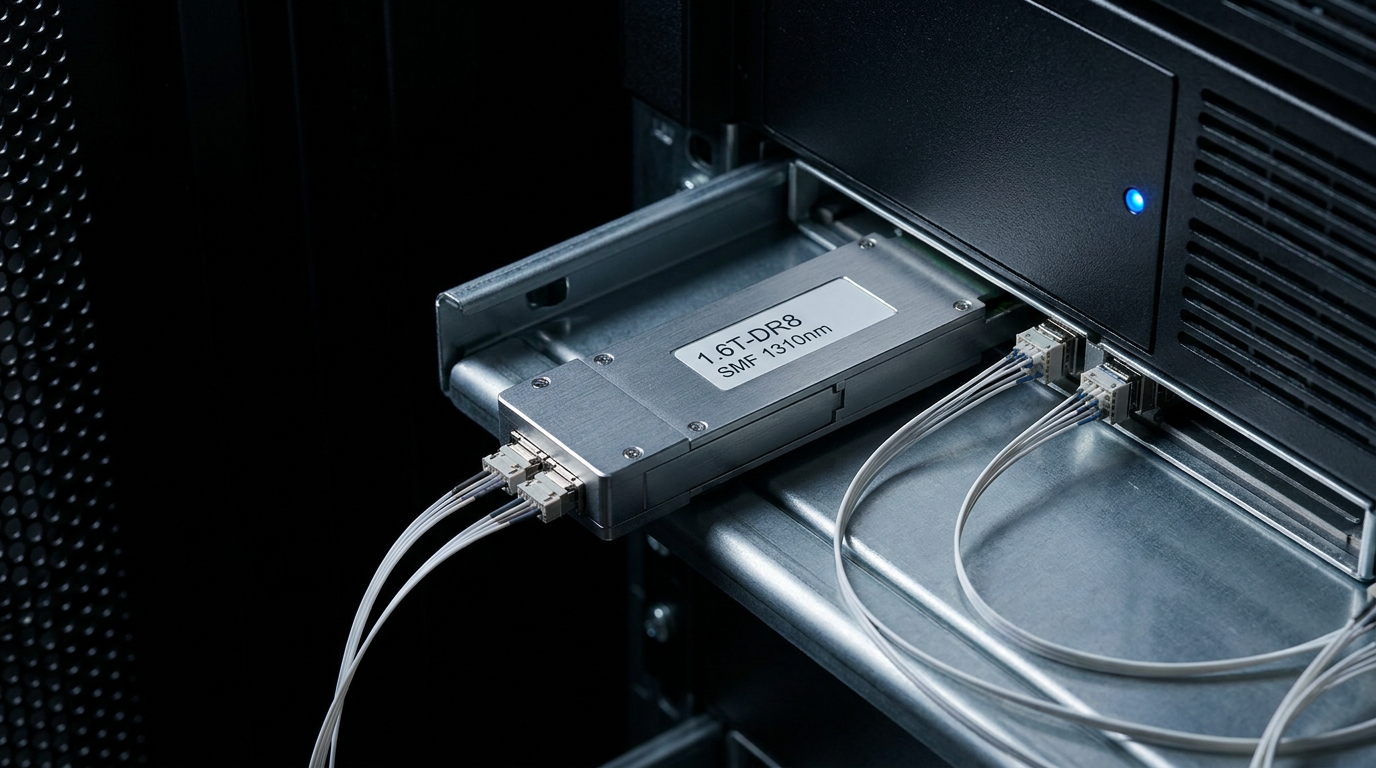
The underlying catalyst resides in the architectural transition governing next-generation artificial intelligence server clusters. As datacenter operators deploy denser accelerator matrices, computational architectures are shifting rapidly from 800-gigabit interconnects to 1.6-terabit transceiver modules, with 3.2-terabit standards already advancing through preliminary validation. At these extreme bandwidth densities, conventional passive copper cabling encounters insurmountable thermal and signal integrity limitations at distances exceeding several meters. Consequently, server backplanes and rack-to-rack interconnects must increasingly rely on optical transceivers, co-packaged optics, and high-specification indium phosphide laser diodes to manage data throughput without triggering unmanageable power draw.
This physical constraint redistributes pricing leverage away from bulk passive glass providers toward the specialized manufacturers capable of engineering reliable optical engines. While legacy fiber deployment remains steady on volume, margin accretion is concentrating within the high-precision optoelectronic interface. Market participants are systematically recalibrating their models to account for this reality, distinguishing between commoditized physical infrastructure and proprietary photonics fabrication where supply remains structurally constrained and qualification cycles span quarters.
Simultaneously, the competitive architecture of datacenter networking is undergoing its own recalibration. Proprietary networking moats, most notably Nvidia's InfiniBand architecture, face intensifying competition from open standard consortia. Backed by industry veterans including Pat Gelsinger, fresh capital commitments totaling hundreds of millions of dollars are flowing into next-generation Ethernet consortia designed to challenge proprietary interconnects. The prospective commercial beneficiaries of an open networking regime extend across merchant silicon designers like Advanced Micro Devices and independent optical component manufacturers whose products integrate agnostic of proprietary switch fabrics. As hyperscalers seek to mitigate vendor concentration risk, demand for modular, high-throughput optical assemblies that interface seamlessly with standard Ethernet switching hardware is accelerating.
These networking developments coincide with complex realignments across the broader semiconductor capital footprint. Ongoing strategic maneuvering surrounding fabrication assets, such as interest from SK Hynix in regional North American sites alongside Intel's industrial realignments, underscores that physical manufacturing capacity remains a focal point of sovereign and institutional balance sheets. Yet within this capital-intensive expansion, raw fabrication capacity alone cannot generate target returns if data pathways between accelerators remain constricted by interconnect latency.
For institutional asset allocators, the performance divergence observed mid-week highlights the necessity of granular structural analysis within the technology hardware supply chain. The initial phase of broad-based multiple expansion across computing infrastructure is giving way to an environment defined by engineering bottlenecks and operational execution. The primary constraint on computational efficiency is no longer solely the volume of compute silicon deployed, but the physical efficiency of photonic data movement, power dissipation, and thermal stability at scale. Investment capital is adjusting accordingly, rewarding those enterprises that govern the narrow optical pathways through which modern computational infrastructure must inevitably flow.
This commentary is provided for general information only and does not constitute investment, legal or tax advice.